


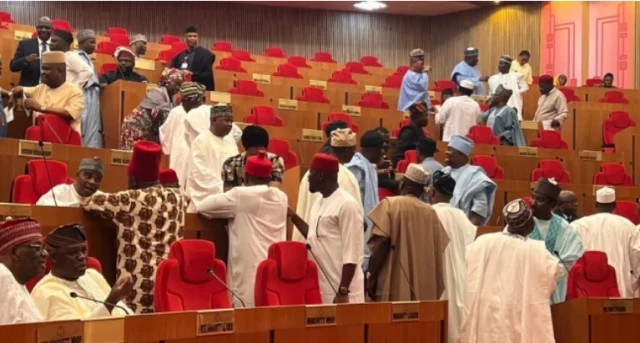
Rowdiness as Nigerian Senate revisits Electoral Act amid public backlash, protests
The Nigerian Senate witnessed a rowdy session on Tuesday as lawmakers revisited Clause 60(3) of the Electoral Act Amendment Bill 2026, which centres on electronic transmission of results.
The atmosphere at the red chamber became tensed when the Senate Chief Whip, Senator Tahir Monguno sought through a point of order, a reversal of the earlier approval granted to Clause 60(3) in the bill by the Senate, a move seconded by Senator Abdul Ningi.
The development caused uproar in the chamber, especially after Monguno read Clause 60(3) without the phrase “real-time”, and replaced the word “transmission” with “transfer”.
Page 45 of the report of the Senate Committee on Electoral Matters, Clause 60(3) of the bill states: “The Presiding Officer shall electronically transmit the results from each polling unit to IREV portal in real time and such transmission shall be done after the prescribed Form EC8A has been signed and stamped by the Presiding Officer and/or countersigned by the candidates or polling agents available at the polling unit.”
Senator Enyinnaya Abaribe who had raised a strong objection to ongoing developments in the chamber, later withdrew his point of order which earlier called for division.
The extraordinary session presided over by the Senate President Godswill Akpabio and attended by 105 senators, was called amid public backlash and protests, after the Senate passed the Electoral Act Amendment Bill 2026, some days back.
A protest, tagged ‘Occupy National Assembly’, was led by Nigerian youths, pro-democracy activists and civil society groups, demanding that lawmakers reverse their position on the electronic transmission clause in the Electoral Act Amendment Bill, which currently does not make electronic transmission of results compulsory.
The protesters insisted that electronic transmission of results was crucial to helping citizens in the country keep faith with the electoral process, while urging the National Assembly to reconsider the clause in the interest of true democracy.



What’s up to every , since I am really keen of
reading this website’s post to be updated daily. It consists of good information.