

Horse’s Mouth News appreciates donations in support of good journalism and quality reportage. (Naira Account, Nigeria)
Account number: 6281917627
Account name: Horse’s Mouth News Media
Bank: Monie Point
Tinubu asks NASS to approve $20.5bn, €1.45bn borrowing plan, amid country’s rising debt burden
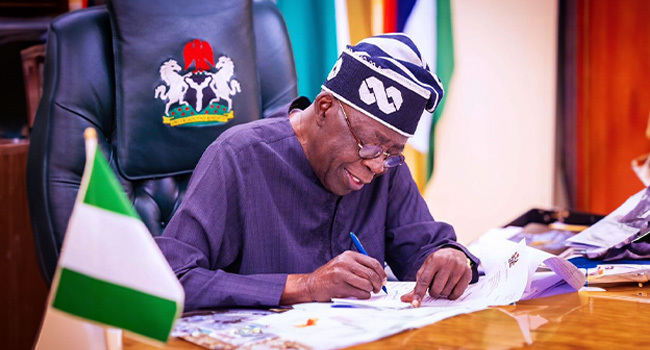
Nigeria’s president Bola Tinubu has requested the National Assembly to approve a supplementary external borrowing plan, amid the country’s rising debt burden.
The $20.5 billion and €1.45 billion plan, according to the president, would fund critical infrastructure, agriculture, education and other key sectors of the economy.
The Federal government had increased its planned borrowing for 2026 to ₦29.20 trillion, projecting a fiscal deficit of ₦31.46 trillion and debt-servicing costs of ₦15.81 trillion.
Nigerians are appalled by the borrowing spree of Tinubu’s government, with the latest proposal coming just barely 7 months to the end of his administration.
Extra resources from the fuel subsidy removal which has inflicted hardship on majority of Nigerians by increasing living cost, has not impacted the Federal Government’s borrowing tendencies in any way.
Nigeria’s revenue had skyrocketed since the president announced the removal of petroleum subsidy in May 2023.
The commencement of the US-Israel war against Iran saw to an exponential increase in the price of crude oil, earning Nigeria excess revenues from crude sale, as a major oil producer.
These developments were expected to free up resources for development, yet, three months to the 2026 general election, Tinubu is seeking NASS approval for another ₦30 trillion.
The government’s defence relied on the purpose of the loan, which it said, is intended to support critical infrastructure and other development priorities.
The hazy aspect of such defence centers on the use of the country’s commonwealth. Critical infrastructures and development priorities can be achieved with the country’s revenues.
Nigerians require an explanation from the Tinubu administration on its spending habit, and for what critical and infrastructural interventions the proceeds from the fuel subsidy removal are being used.
The administration had partly blamed the rising debt profile of the country on the effects of naira depreciation on external debt, the same naira depreciation that the administration vehemently saw to.
NASS had in 2025 approved a $2.347 billion external borrowing request to aid the financing of the 2025 budget deficit and refinance maturing Eurobonds, alongside a proposed $500 million sovereign sukuk for infrastructural projects.
The rationale behind the governments irrationality and financial irresponsibility should be called to question. Its lack of public sympathy, even as the citizens suffer in the agony of economic hardship caused by rising fuel prices and unusual inflation across the spectrum of the economy, also needs to be checked.
John Ewah is the publisher and chief editor Horse’s Mouth News